Explore 2025’s artificial turf price ranges, key cost drivers, and Turflory’s tailored solutions—find the perfect balance of quality, budget, and project needs.
Artificial turf has become a go-to choice for homeowners, businesses, and sports facilities alike—offering low maintenance, water savings, and year-round greenery. But before starting your project, understanding how much artificial turf costs is critical for accurate budget planning. This guide breaks down pricing models, cost-influencing factors, Turflory’s product lineup with 2025 price ranges, and how to calculate your exact material needs.
Artificial turf is almost exclusively priced per square meter (m²)—the industry standard for transparency. When comparing artificial grass prices, you’ll find that cost correlates directly with product quality and performance. Higher-priced turf typically includes:
✅ Thicker, more realistic fibers
✅ Superior UV resistance (no fading over time)
✅ Higher pile height (length of grass blades) and face weight (grams of fiber per m²)
✅ Durable backing (prevents tearing or shifting)
✅ Specialized features (e.g., cooling tech, pet-friendly coating, sports performance)
For most buyers, the goal is to find a turf that meets your usage needs (e.g., low-traffic balcony vs. high-use sports field) without overpaying for unneeded features.
Not all artificial turf is created equal—these four factors account for 80% of price variation:
Pile height (grass length) and face weight (fiber density) are the top determinants of cost, as they directly affect durability, comfort, and realism.
• Short-Pile Turf: Pile height ranges from 20–30 mm, with a face weight of 280–350 g/m². It’s the most budget-friendly option, ideal for balconies, rooftops, and decorative areas where foot traffic is minimal.
• Medium-Pile Turf: The most popular category, with a pile height of 30–40 mm and face weight of 350–500 g/m². It strikes a balance between natural appearance and affordability, making it perfect for backyards, gardens, and residential landscapes.
• High-Pile Turf: Pile height of 40+ mm and face weight of 500+ g/m², offering a luxurious, lush look. It’s the priciest option, designed for luxury villas, commercial spaces, and premium yards where aesthetics and comfort are top priorities.
Higher face weight means more fiber per square meter—resulting in a fuller lawn that resists flattening, even in high-traffic areas.
Turf fibers are made from three primary materials, each with distinct price points and performance characteristics:
• PP (Polypropylene): The most affordable material, with a raw cost of 2–4/m². It has a stiffer texture and is best suited for budget projects, low-traffic areas, or temporary installations (e.g., event spaces). PP turf has a shorter lifespan of 5–8 years.
• PE (Polyethylene): The mid-range option, with a raw cost of 3–7/m². It offers a soft, natural feel that mimics real grass, making it the most popular choice for residential landscaping, pet areas, and playgrounds. PE turf balances durability (8–12 year lifespan) and affordability—Turflory’s top-selling material.
• Nylon: The premium, high-performance material, with a raw cost of 6–12/m². It’s extremely durable, resistant to tearing and fading, and designed for sports fields (soccer, golf), commercial high-traffic areas, or heavy-use pet runs. Nylon turf has a lifespan of 12–15+ years.
• Backing: Basic single-layer backing is the most cost-effective (1–2/m²), while reinforced, drainage-focused backing (critical for soil or concrete installations) adds 0.5–1.5/m². Reinforced backing prevents shifting and improves water flow, extending turf lifespan.
• Infill: Optional for short-pile turf, but required for high-pile or sports turf to keep fibers upright. Infill costs range from 1–3/m² for silica sand (budget-friendly) to 4–6/m² for eco-friendly rubber or cork blends (premium, shock-absorbing).
Reputable brands like Turflory include longer warranties (8–15 years) and rigorous quality control—adding 0.5–2/m² compared to generic, no-warranty turf. This premium is worthwhile: generic turf often fades or tears within 3–5 years, requiring costly replacement, while Turflory’s warranty covers manufacturing defects and fading.
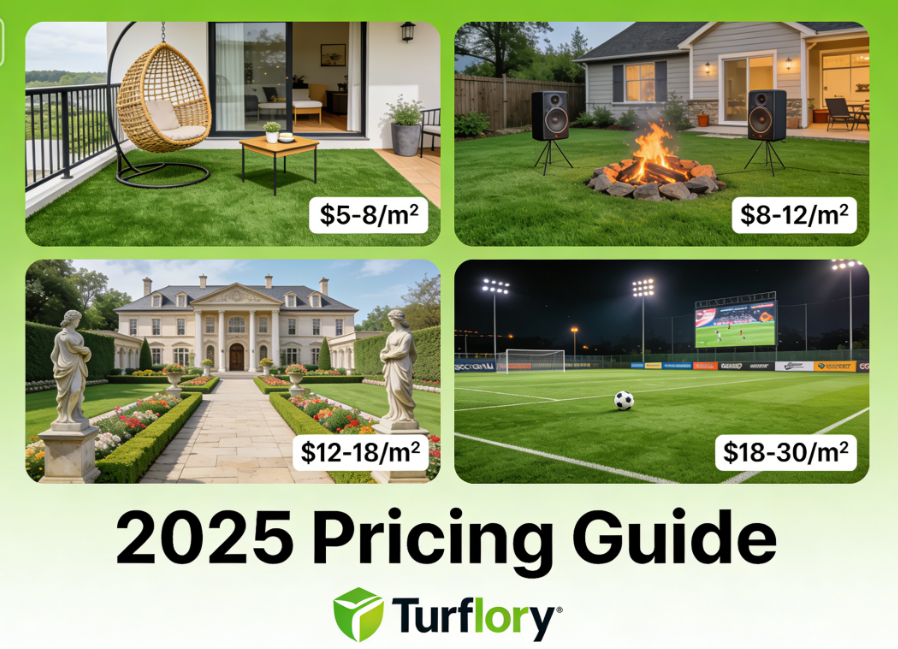
Turflory’s pricing includes materials, backing, and standard packaging—no hidden fees. Below are the 2025 price ranges for core product categories, tailored to different budgets and applications:
• Price Range: 5–8/m²
• Key Features: PE/PP blend fibers, 25–30 mm pile height, 300–350 g/m² face weight, single-layer backing.
• Best For: Small yards, balconies, rooftops, low-traffic areas, or DIY projects.
• Lifespan: 5–8 years
• Explore Now: Turflory Landscape Turf
• Price Range: 8–12/m²
• Key Features: 100% PE fibers, 35–40 mm pile height, 400–500 g/m² face weight, reinforced drainage backing, multi-tone color (for natural realism).
• Best For: Backyards, gardens, pet areas, playgrounds, and mid-to-high-traffic residential spaces.
• Lifespan: 8–12 years
• Explore Now: Turflory Residential Turf
• Price Range: 12–18/m²
• Key Features: High-pile design (40–50 mm), 500+ g/m² face weight, soft-touch PE fibers, anti-static coating, premium drainage backing, 4-tone color blending (mimics real grass texture).
• Best For: Luxury villas, commercial courtyards, high-end landscaping, and areas where realism and comfort are top priorities.
• Lifespan: 10–15 years
• Price Range: 18–30/m²
• Key Features: Nylon/PE hybrid fibers, 40–60 mm pile height, 600+ g/m² face weight, shock-absorbing backing, infill-compatible design (meets sports safety standards).
• Best For: Soccer fields, golf putting greens, tennis courts, and commercial sports facilities.
• Lifespan: 12–18 years
• Explore Now: Turflory Sports Turf
Avoid overbuying or running short—follow these simple steps to calculate the total turf you need:
• For rectangular/square areas: Multiply length by width (e.g., 7 m × 5 m = 35 m²).
• For irregular shapes (e.g., curved yards, L-shaped balconies): Divide the area into smaller rectangles, calculate each section’s square meterage, and add them together (e.g., 4 m × 3 m + 5 m × 2 m = 12 m² + 10 m² = 22 m²).
• Use a measuring tape for accuracy—round up to the nearest 0.5 m to avoid underestimating.
Turf rolls come in standard widths (2 m or 4 m), so you’ll need to trim it to fit your space. Add 5–10% extra to your total square meterage:
• For regular shapes (rectangles/squares): Add 5% (e.g., 35 m² × 1.05 = 36.75 m² → round up to 37 m²).
• For irregular shapes (curves, angles): Add 10% (e.g., 22 m² × 1.10 = 24.2 m² → round up to 25 m²).
This extra accounts for offcuts and ensures you have enough turf to cover seams or mistakes.
Turflory’s turf rolls are available in 2 m or 4 m widths. When planning, align the roll width with your area’s dimensions to minimize waste:
• Example: A 6 m wide yard → use 4 m + 2 m rolls (no extra width waste) instead of three 2 m rolls (if length allows).
If you’re unsure about measurements or layout, Turflory’s team can help calculate your exact needs: Turflory Contact Page
Artificial turf prices in 2025 range from 5–30/m², depending on material, pile height, face weight, and application. Turflory’s product line covers every budget: from economy turf for small decorative spaces to premium sports turf for professional facilities.
The key to cost-effective buying is matching the turf to your usage: don’t overpay for high-pile luxury turf if you’re installing it on a low-traffic balcony, and don’t skimp on durability for a high-use backyard or sports field.
By understanding the key pricing factors and calculating your exact material needs, you’ll make a smart investment that delivers years of low-maintenance greenery. For personalized recommendations or project-specific quotations, reach out to Turflory’s experts anytime—we’re here to help you find the perfect turf at the right price.